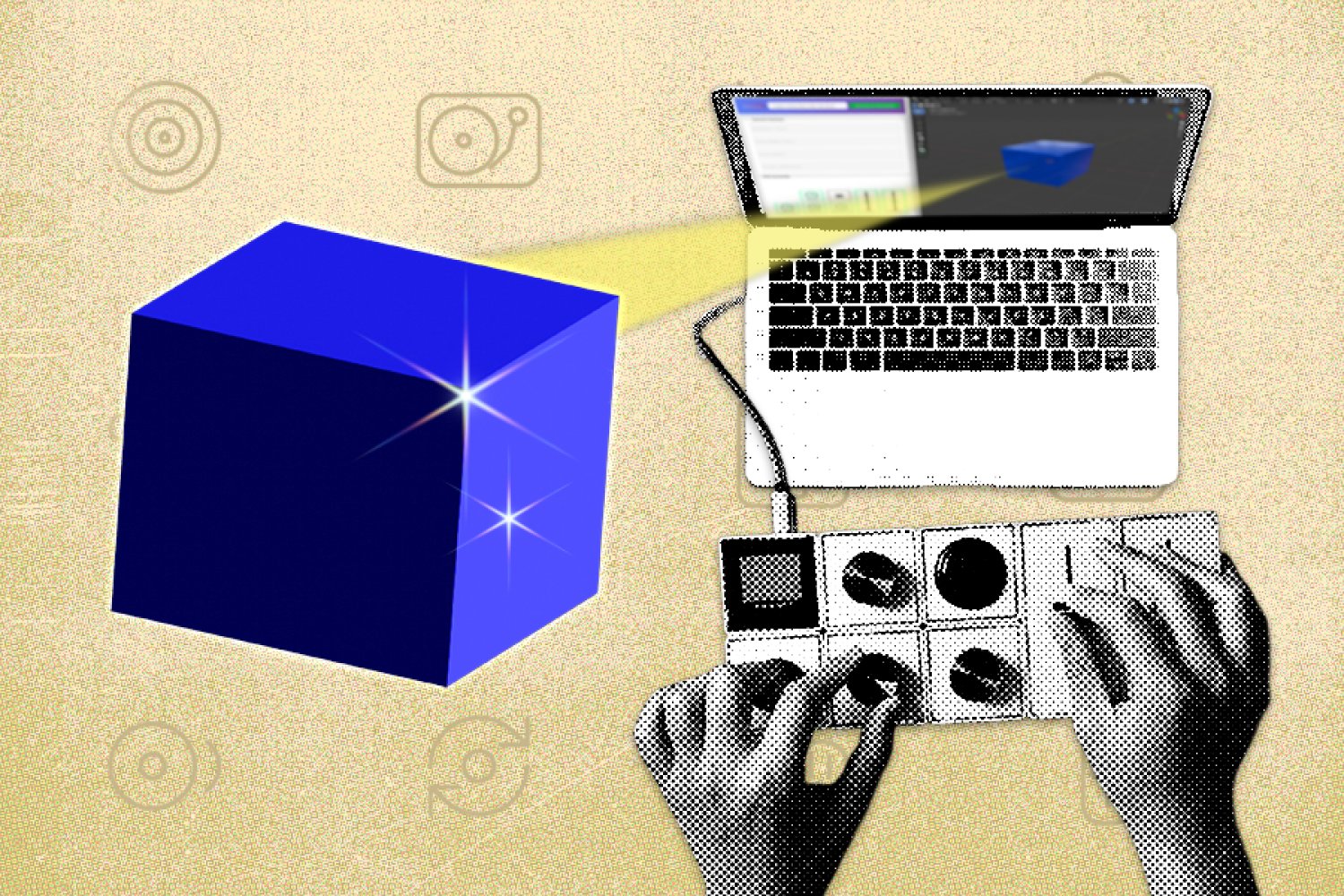
The system helped the researchers turn a standard mixer into a photo-editing controller. That way, they could adjust color in Adobe Lightroom, with a complementary visualization of those controls displayed on their screen. The team did the same with sound-mixing software, so that performers can adjust their music in real-time with their own inputs to knobs and faders.
The researchers also reprogrammed a simpler mixer to work with the 3D modeling program Blender. Their interface included an area where users can type in a prompt, and once the model was generated, users could adjust features like shininess on a mixer using physical controls. Within Adobe’s Character Animator software, TangiMap connected specific expressions and movements to buttons on a control pad so users could animate (or “puppeteer”) a cartoon character live.
Zhu and co-author Chang Xiao, an assistant professor at Boston University, presented their tool at the ACM Symposium on User Interface Software and Technology earlier this month.
Zhu and Xiao created a custom user interface (UI) for each application. While that adds another layer of personalization to the creative process, the team is hoping to create a more streamlined system that helps the designer to generate the UI for their device by taking a picture.
The researchers are also considering the physical aspects of user interactions. They want to use more ergonomic devices and also ensure that TangiMap accounts for where users position their hands when doing different tasks. For example, users typically hold a mixer differently when they’re using it to make music than, say, when playing a video game. You may want controls mapped closer or further apart, depending on what you’re doing.
Zhu is hoping to do a user study to get more feedback about TangiMap, and whether this kind of “smart DJing” could indeed improve those experiences. But the dynamic reprogramming she ultimately envisions is even more ambitious.
“The same way our phones and computers generalize to a range of tasks, we want other objects to be more intelligent,” she says. “I would like to build physical items that use an AI agent as a brain to decide what to reprogram into. They could understand what to transform into, given a specific situation.”
A chemical jar, for instance, could tell you if it’s sealed correctly when asked, and when you want to see what it’s typically used for, the container would instead display that information. While that kind of versatility and interactivity is a ways off, more powerful agents and more intricate fabrication pipelines could bring everyday objects to life.
Their work was supported, in part, by Google’s Gemini Academic Program Award.